
A Hamilton plumber rang us last month with a name he liked and a decision he could not make. One mate had told him .co.nz looks more trustworthy to locals. Another swore .com is the only one that counts. He had been stuck on it for a fortnight. Choosing a domain extension should take about ten minutes, and the gap between the sensible options is smaller than most people fear.
It does still matter, though. Your domain goes on the van, the invoices and every email address in the business. Changing it later means reprinting things and re-teaching customers. It also shapes what a stranger assumes about you before your page has even loaded. So here is how we talk this through with customers, what the .nz registry actually allows, and the one case where paying for two names earns its keep.
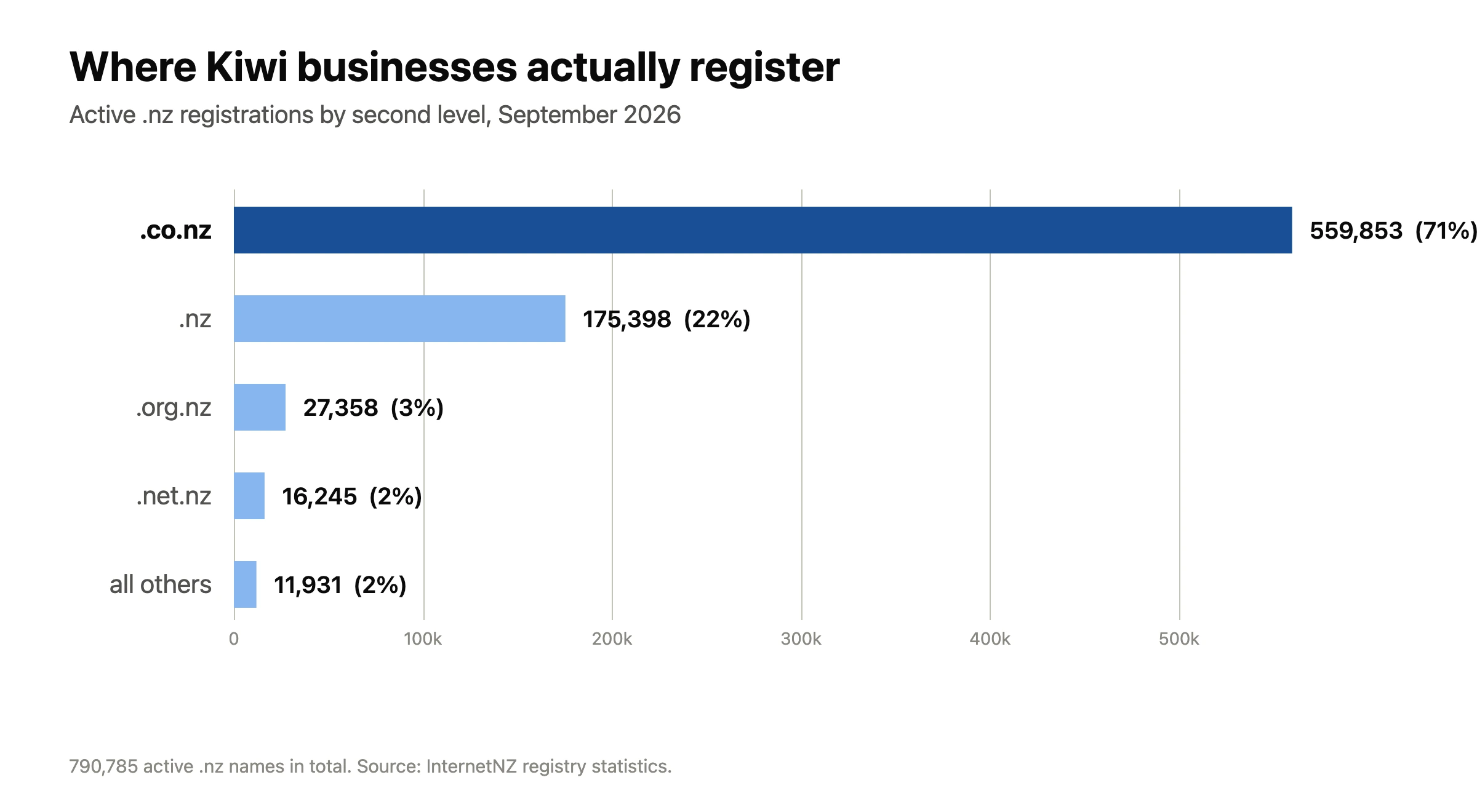
Active .nz registrations by second level, September 2026. Source: InternetNZ registry statistics.
What a domain extension signals to a customer
Most people never think about the bit after the last dot until they have to choose one. Then it feels enormous. In practice a domain extension does one job. It tells a visitor roughly what kind of outfit they have landed on, before they have read a word of your copy.
A .co.nz says New Zealand business. For a plumber, a cafe or a physio clinic, that is exactly the right message. A .com says something broader, and usually something bigger, but it carries no country with it at all. A .nz sits between the two. It reads local and modern, and it is shorter to say out loud. That matters more than you would expect when you are reading your email address down the phone to a customer.
The .nz family, and how big .co.nz really is
New Zealand has one country code, and underneath it sits a set of second levels. Most Kiwi businesses only ever consider two of them, and the registry numbers show which domain extension they land on.
At the end of September 2026 there were 790,785 active .nz names. Of those, 559,853 were .co.nz, which is about 71 per cent of the lot. Direct .nz names came second on 175,398, or roughly 22 per cent. After that the drop is steep, with 27,358 .org.nz names and 16,245 .net.nz. InternetNZ publishes the monthly registry statistics if you want to watch the trend yourself.
Every remaining domain extension has a narrower purpose. Use .org.nz for a not-for-profit, .net.nz for internet infrastructure and service providers, and .kiwi.nz or .geek.nz if the personality fits. Then there are the moderated ones, including .govt.nz, .ac.nz, .school.nz, .health.nz and .iwi.nz. Those carry eligibility rules, and the registry checks them before issuing a name, so a retail business will not be getting one.
Choosing a domain extension when your customers are local
If everyone who pays you lives in New Zealand, take the .co.nz. Take the .nz as well if it is free. For most trades, clinics, cafes, salons and shops that is the entire decision. Choosing a domain extension for a local audience really is that simple, and it is what we suggest when someone asks us to pick for them.
Google treats a country code like .nz as a signal that a site is aimed at that country. It is one signal among dozens, so do not expect miracles from it. A .com with New Zealand content, a local address and local reviews still ranks perfectly well here. We went through the related question of where your server should sit in NZ hosting versus Australian hosting, and the short version is that proximity helps a little while content helps a lot.
A local domain extension carries a practical advantage too. A good .co.nz is often still free when the matching .com went years ago. Something like harrisplumbing.com disappeared a decade back. The .co.nz version may well be sitting there waiting for you.
When .com is the better call
Selling beyond New Zealand changes the maths. If you ship to Australia, sell software overseas, run a subscription product or chase offshore investors, the right domain extension is usually .com. Nobody in Dallas needs to learn what .co.nz means first.
Saying it out loud matters as well. "Dot com" takes one breath. "Dot see oh dot en zed" takes four, and people mishear it constantly. So if your business runs on phone enquiries and word of mouth, that is a genuine cost. The price difference between the two is small enough that it should not decide this for you either way.
The registry rules worth knowing first
Before you commit to a domain extension, a few of these tend to surprise people:
- There is no residency test. You do not have to live here to hold a .co.nz. An Australian company can register one this afternoon.
- Most second levels are open. Only the moderated ones check who you are. Nobody audits whether a .co.nz holder is really a commercial business.
- Direct .nz has been open since 2015. Existing holders got a reservation window first, and it closed in March 2015. Anything nobody claimed went into the general pool.
- Transfers need a UDAI. Moving a .nz name between providers requires the Unique Domain Authentication ID from your current provider. Ask for it before you start, not halfway through.
- You buy through a provider. InternetNZ runs the register itself, while authorised registrars and resellers sell the names and handle your renewals.
The Domain Name Commission publishes the .nz rules in full, and they read more plainly than most documents of that sort. Our own domain registration page lists what we can register on your behalf.
Should you hold more than one name?
Sometimes, yes. If the name is your brand, a second domain extension is cheap insurance, so hold the .co.nz and the .nz together. Point one at the site and redirect the other. That stops somebody trading off your name later, and it costs far less than arguing about it afterwards.
Do not build two websites, though. The same content on two addresses splits your search signals and doubles your maintenance for no gain. One site, one main address, a 301 redirect on the spare. Adding the second name to your hosting takes a couple of minutes, and our guide on adding a domain in cPanel walks through the screens.
What about .shop, .online and the rest?
Hundreds of newer endings exist now, and some of them are genuinely good. A gallery on .studio or a retailer on .shop can read well. Still, two things hold them back for a small New Zealand business. Recognition is one, because a customer who half-remembers your name will type .co.nz out of habit and land nowhere.
Renewal pricing is the other. A newer domain extension can be cheap for the first year and considerably dearer afterwards, so check the renewal price rather than the sign-up price. Our notes on why a .nz name suits a Kiwi business go further into the local angle. If you love one of the newer endings, hold the .co.nz alongside it and redirect.
How to pick a domain extension in ten minutes
Work down this list once, settle on a domain extension, then register it and get on with your week. Perfection here is not worth another fortnight of deliberating.
- Write down who actually pays you. If the answer is New Zealanders, your domain extension is already decided.
- Check the .co.nz and the .nz for your preferred name at the same time.
- Say each option out loud to somebody. The one they spell back correctly wins.
- Check the .com as well, even if you do not want it. A big overseas company sitting on it means some confusion later.
- Avoid hyphens and numbers. They survive print badly and get lost completely over the phone.
- Register for at least two years, turn on auto-renew, and send the renewal notices to an inbox somebody reads.
That last step prevents the most common outage we see all year. An expired domain takes the website and the email down together, and the owner usually hears about it from a customer first. Our guide on what to check when your website goes down works through the rest of the causes.
Domain extension questions we get asked
Is .co.nz better than .com for a New Zealand business?
For a business whose customers are all here, usually yes. It reads local, it is easier to get, and the country code gives Google a small geographic hint. If you sell overseas as well, the .com is worth the extra explaining.
Can I register the .nz if someone else holds the .co.nz?
Yes, unless they reserved it during the window that closed in March 2015. Everything unclaimed went into the general pool, so plenty of good .nz names remain free today. Check both spellings before you settle on anything.
Does changing my domain extension hurt my Google ranking?
It can dip for a few weeks. Set up 301 redirects from every old address to its new equivalent, keep the old name renewed in your own name, and update your Google Business Profile. Most sites we move recover inside a month or two.
Need a hand?
If you are weighing up a name, our team will check what is free and tell you honestly which domain extension we would take. We handle domain registration including .nz, and annual NZ hosting plans come with a free domain for the first year. Our support team runs 24/7 if you get stuck mid-setup, and the knowledge base covers the cPanel side of it. You can also read what our customers say about us on Trustpilot.